Pauline Jackson

Manufacturing leads the UK on robots and specialist kit, yet only around one in five manufacturers use AI. Half of those that do have trained no staff. The reasons say more about how AI has been sold than about the sector itself.
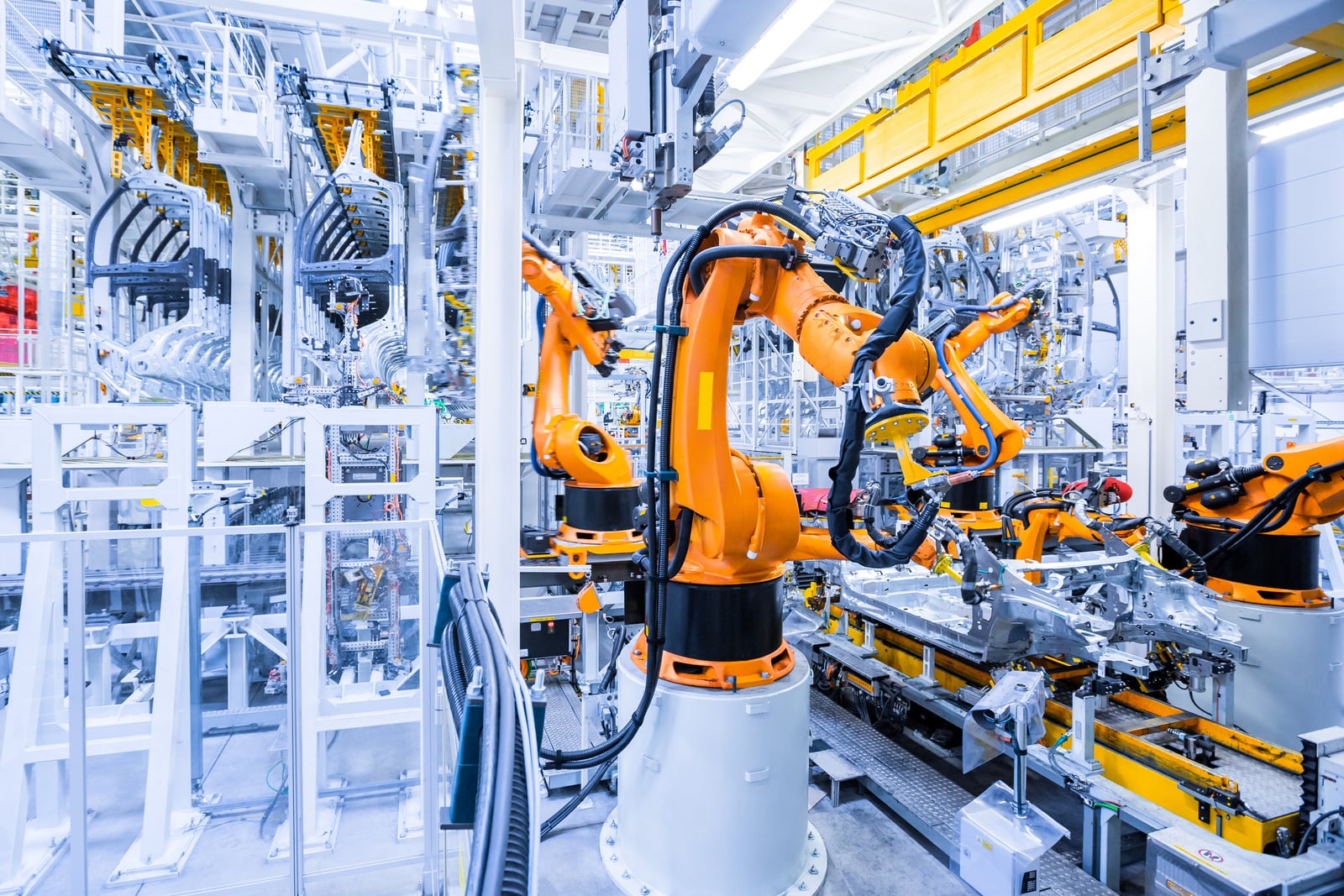
Walk onto the floor of a typical Midlands manufacturer and you’ll see a lot of money tied up in machinery. CNC lines, robot cells, and inspection rigs took years to justify and months to commission.
Then walk into the office. Someone is copying figures from one spreadsheet into another to build a quote.
That contrast sums up manufacturing’s relationship with artificial intelligence (AI). The sector has plenty of appetite for technology. What it lacks is a reason to trust AI, a person to own it, and the time to learn it.
The Most Automated Sector Is Lagging on AI
In June 2026, 21.6 per cent of UK manufacturers used at least one AI technology. That’s how the Office for National Statistics (ONS) defines a business as “using AI”. Tecvia, a Manchester-based Microsoft partner, set out the figures in its AI adoption statistics study.
That share has more than tripled since September 2023, when it was 6.7 per cent. The trend is set out in the ONS report Artificial Intelligence in UK Businesses: 2023 to 2026. Yet it still trails the 28.9 per cent of all UK businesses using AI. Among information and communication firms, the figure is 58.3 per cent.
Now set that against an earlier ONS study of management practices in UK firms. In 2023, 64 per cent of manufacturers used specialised equipment and 14 per cent used robotics. For service firms, the figures were 31 per cent and 3 per cent.
So manufacturers will spend serious money on technology when they can see what it does. AI hasn’t passed that test yet. These figures are UK-wide rather than regional. But in the Midlands, where so much of the economy is built on making things, the gap matters more than in most places.

AI Has Been Sold to the Office, Not the Factory
Look at where manufacturers put AI once they have it. Make UK’s June 2026 report on AI and skills found 83 per cent use it in HR, finance, and admin. Only 11 per cent use it in production, 7 per cent in supply chain, and 6 per cent in quality control.
That isn’t surprising when you think about how AI arrived. For most firms, it turned up as a chat window that writes emails, summarises documents, and drafts job adverts. Those are office tasks. A production director could be forgiven for deciding AI wasn’t meant for them.
The ONS figures point the same way. Nearly a quarter (23.1 per cent) of AI-using manufacturers say none of their staff use AI in their daily work. Most (62.1 per cent) use it on a limited basis, and only 11.2 per cent use it extensively.
Caution on the Line Makes Sense. In the Office, It’s Costing You
Manufacturers have good reason to be careful. In June 2026, Professor Chris Dungey, the government’s AI Champion for Advanced Manufacturing, published a plan for scaling AI in factories. It warned that too many promising AI projects remain “trapped in pilot phases”, with trials that never reach full production.
The barriers it lists will sound familiar on any shop floor. They include legacy production systems, scattered data, unclear returns, and worries about safety. AI on a production line has to work every time, alongside people and machinery. A tool that’s right most of the time won’t do for a tolerance or a safety check.
That caution belongs on the line. The trouble is that it seems to have spread to the office, where the risks are far lower. A clumsy AI draft of a supplier email takes a minute to fix. Treat every use of AI like a capital project, and the easy wins never get tried.
It shows in the plans, too. Three in four manufacturers (75.1 per cent) have no plans to adopt any AI technology in the next three months.
Free Tools, No Owner, and No Training
Where AI has got into manufacturing, it has mostly come in through the side door. Almost half (49.1 per cent) of AI-using manufacturers got it through free-to-use software. That’s ahead of bought software (34.6 per cent) and tools built in-house (14.9 per cent).
Spending is low to match. Of AI-using manufacturers, 42.4 per cent have invested nothing in AI over the past 12 months. A further 29.8 per cent have spent under £10,000.
Then there’s training. Half of AI-using manufacturers (50.3 per cent) have trained no staff in it. That’s worse than the 46 per cent of all AI-using UK businesses.
Read those figures together and a pattern appears. When a tool is free, nobody signs off a budget. Without a budget, nobody owns the project. And when nobody owns it, nobody books the training.
Meanwhile, staff are moving faster than their employers. The ONS Opinions and Lifestyle Survey found that 55 per cent of workers use AI for work, against about a third of businesses. In plenty of firms, AI is already in use. Nobody is managing it.
Training Has to Fit Around the Shift Pattern
Ask businesses what’s holding them back, and the ONS finds a shortage of AI skills comes up most often, ahead of cost. Make UK found the same in manufacturing, with more than half of firms naming skills shortages as their main barrier.
Factory training is harder to arrange than office training. Operators work shifts, and a line can’t stop for a two-hour session. In a smaller firm, the same few people often run operations, quality, and improvement. Make UK’s report calls for flexible, shift-friendly training built around real factory work. That it needs calling for says a lot.
Data is the other gap. AI can only work with the information it’s given. If quotes live in one spreadsheet, stock in another, and orders in a third, any tool is working from an incomplete record.
Firms that run on a single enterprise resource planning (ERP) system, such as Dynamics 365 Business Central, give AI firmer ground to work from. Many of those systems now build AI in, so the tools sit on top of data the business already trusts.
The Midlands Has a Chance to Move First
With most of the sector holding back, a modest start goes a long way. A Midlands firm that gets AI working in a few office jobs, with trained people using it, will be ahead of most competitors.
That start doesn’t need a robot or a big budget. It needs someone to own it and a willingness to train the people who’ll use it. Help is available, too. Made Smarter, the government-backed programme for small and medium-sized manufacturers, runs in both the West and East Midlands.
Manufacturers already know how to adopt new technology. They do it every time they buy a machine. They test it, train people on it, and measure what it produces. AI deserves the same treatment, starting in the office rather than on the line.